History of the Bosnian Arabian horse
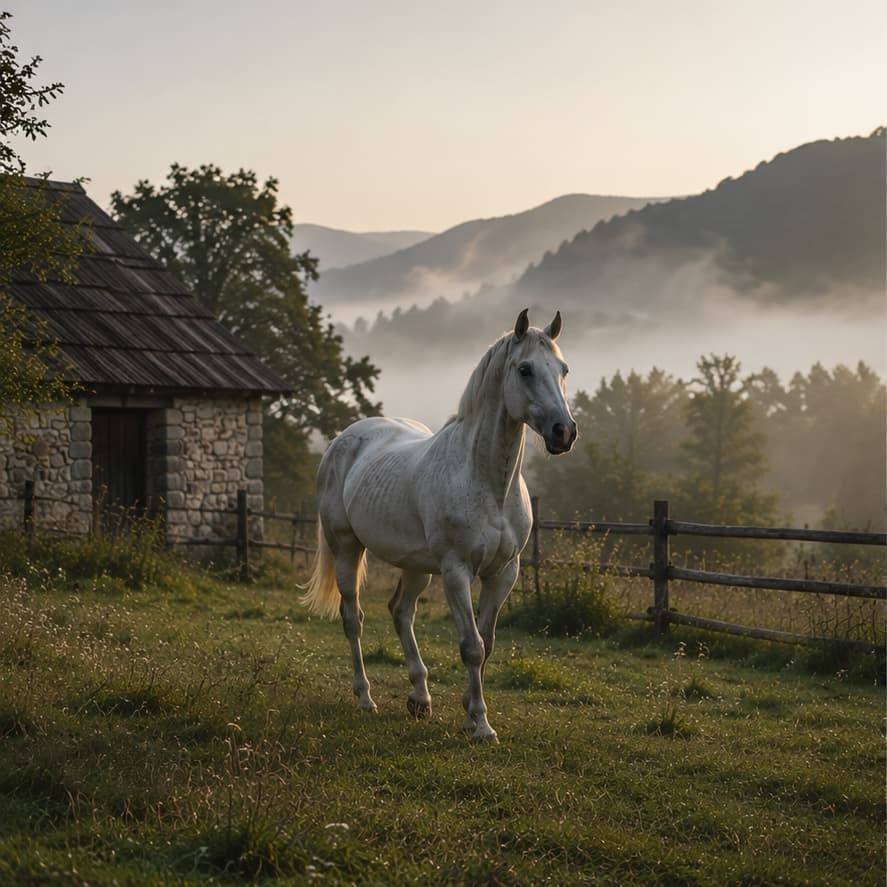
The breeding of Arabian horses in Bosnia and Herzegovina has a rich tradition spanning over 134 years. Through continuous work and strict selection, a type of horse has been developed that is smaller and more elegant, ideal for crossbreeding and improving the characteristics of the Bosnian mountain horse, while retaining all the noble qualities of the original desert Arabian horses.
Beginnings of breeding
Organised stud breeding of Arabian horses in Bosnia and Herzegovina began in 1895, when the first stallions and mares were imported from Syria and placed in Butmir near Sarajevo. The initial goal was to enhance the Bosnian mountain horse, but the results were so successful that the Austro-Hungarian authorities decided to expand the breeding programme to include purebred Arabian horses.
Due to limited space, the stud was relocated in 1898 to Borike near Rogatica, where modern facilities were built and pastures organised. During the First World War the stud was temporarily moved to Modriča and Borje, returning in 1923 to Sarajevo, to the Dolac Malte and Kotorac locations, where it had access to the Butmir racecourse and summer pastures on Mount Igman.
Breeding stallions and mares
Since the establishment of the stud until today, 99 stallions have been used in breeding. In the early years, original desert stallions were used: Massud, Maneghie Abaali, Simhan, Ferhan El Nejd, Siglavy Gidran, O’Bajan, Shehun, Mishur, and others. Influenced by European trends, in 1918 the stallion Shagya X–13 was purchased from the Radauc stud; however, his offspring did not meet the desired type and were gradually removed from breeding.
The most important stallion lines that shaped the Bosnian Arabian horse are: Gazal, Ilderim, Lenkoran, El Hafi, Siglavy, Kuhaylan Zaid, Sabih, and Mabrouk. Among mares, the most notable early lines were Kadina, El Hafi, Hamdani, O’Bajan, Luna, Fehra, and Darinka. Each of these lines, through selective breeding and adaptation to local climatic conditions, made a strong genetic contribution to the breed.
Stud books and registration
Stud books for Arabian horse breeding in Bosnia and Herzegovina have been meticulously maintained from 1895 to the present. They include all stallions and mares, their lines and offspring, coverings and foals, allowing for the creation of detailed pedigree records of up to five generations today. The continuity of breeding was preserved even after the Borike stud was disbanded, thanks to private breeders and the dedication of specialists.
The Bosnian Arabian horse today
The Bosnian Arabian horse is characterised by a harmonious appearance, elegance, and a high percentage of blood from original Arabian horses. Its conformation has changed very little since the Second World War. Today, thanks to the work of private breeders and the Borike stud, the number of Bosnian Arabian horses in Bosnia and Herzegovina, Croatia, Serbia, and Montenegro continues to grow, with breeding based on historical stallion lines and mare families, preserving the genetic authenticity of the breed.
The breeding of the Bosnian Arabian horse represents a combination of tradition, science, and love for horses, making this breed unique, highly valued, and recognised among enthusiasts and experts worldwide.
Key moments
Milestones in 134 years of breeding the Bosnian Arabian horse.
1895
Stud farm founded
The first Arabian mares and stallions from Syria arrive at Butmir in Sarajevo. Selective breeding begins.
1898
Borike
A summer pasture is organised for the stud farm at Borike near Rogatica, at 1,000 m altitude.
1930
Relocation
The stud farm moves permanently to Borike. At its best, over 400 horses in one place.
1945
After the war
Several mare lines are lost during the Second World War. Through great effort, most of them return.
1980
Golden era
Bosnian Arabian horses win at domestic and international fairs. The stud farm is at its peak.
1992
War in BiH
The number of horses drops by 68%. Stud farms are destroyed and horses lost. The breed is on the brink of extinction.
2020
UUBAK founded
Adnan Delić founds the Association of Breeders and Lovers of the Bosnian Arabian Horse. An organised recovery begins.
2026
WAHO membership
UUBAK becomes an affiliated member of the World Arabian Horse Organization — international recognition for the quality of its breeding.